This is a relatively rare type of surgery, with only a small number of similar procedures performed in Israel and worldwide. The surgery was performed on a 14-year-old girl from the Galilee, who came to Hillel Yaffe Medical Center with a congenital hand deformity. Over the years, the condition caused her hand to bend almost completely, leading to pain and severely limited movement. This deformity makes up approximately 2% of all upper limb deformities in children. If left untreated, it leads to significant movement limitation as the child grows.
After assessing feasibility, the surgery was performed by three doctors from Hillel Yaffe’s Orthopedics Division: Director of the Hand Orthopedics Unit, Dr. Boaz Granot and Dr. Mohammad Younis, Senior Physician in the Hand Surgery Unit, together with Dr. Eyal Mercado, a pediatric orthopedics specialist.
"The deformity caused an abnormal structure of one of the ligaments in the hand," said Hand Surgery Unit Director Dr. Boaz Granot. "As the girl grew, her hand lengthened, but one part of the growth plate closed, while the other part continued to grow unevenly. This is what caused the bone and joint to rotate sideways and become deformed. Over time, it became painful and caused significant limitation in movement."
"While children with disabilities learn to adapt to their condition," said Dr. Eyal Mercado, a pediatric orthopedic specialist in the Orthopedics Division who participated in the surgery, "in this case, once she began experiencing severe pain and a serious loss of mobility, it was clear that immediate surgical intervention was required.”
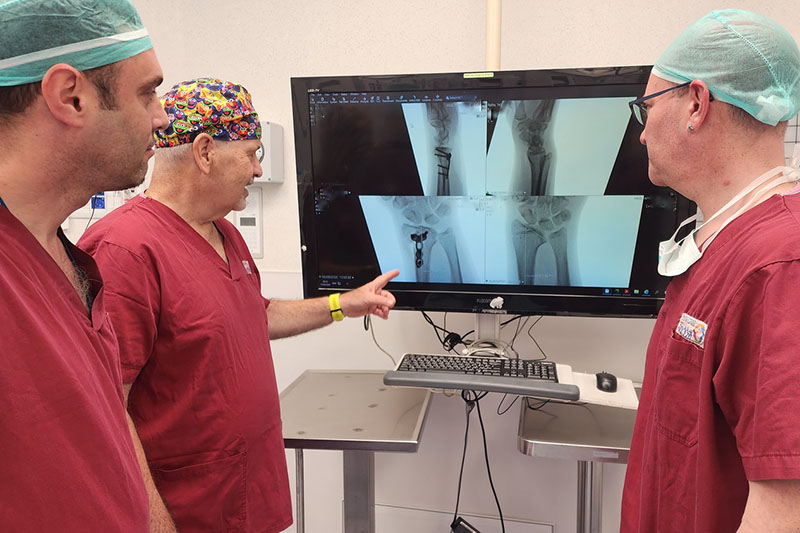
Dr. Boaz Granot, Dr. Mohammad Younis and Dr. Eyal Mercado from the Orthopedics Division at Hillel Yaffe examining X-ray images before and after surgery
Complex surgery during adolescence
As previously mentioned, the medical challenge was particularly complex because the young woman is still growing. "We had to plan the surgery very carefully, because if we only corrected the existing deformity without treating the underlying cause, the bone would continue to grow unevenly, and the deformity would return and worsen.”
During the surgery, the team used a two-stage therapeutic approach: First they corrected the existing deformity and then performed a controlled closure of the growth plates to prevent the deformity from recurring.
"We correct the current deformity and also close the plates, so the problem won't return," said Dr. Mohammad Younis, a senior physician in Hillel Yaffe's Hand Unit. "The result is less pain and significantly improved ranges of motion."
As noted, the teenager successfully underwent surgery on one hand. She was hospitalized for several days and then discharged home to continue her recovery, after being fitted with a splint by the occupational therapy team. She is also scheduled to have surgery on the other hand at a later date.
The doctors who participated in the surgery agree, "Performing this surgery highlights the importance of precise medical intervention during adolescence, when bones are still growing. It is equally important that the surgery be performed by specialists with extensive expertise and a deep understanding of growth processes in children. This case demonstrates how precise medical intervention at the right time can dramatically change the future of a young patient."








.jpg?BannerID=39 "youtube channel")