A joint study that marks the first of its kind, conducted by Hillel Yaffe Medical Center and Reichman University examined the effects of a small robot placed in an emergency room that performs empathetic gestures toward waiting patients. The results were significant: lower stress levels, more smiles, and even attempts by patients to befriend the robot, which is about the size of a desk lamp, and to seek out its company.
"Anyone who has ever had to spend time in a hospital emergency room knows the feeling of stress, anxiety and uncertainty," said Dr. Dikla Dahan-Shriki, Deputy Director of Hillel Yaffe Medical Center, who led the joint study on behalf of the hospital. "Arriving at the hospital is almost always accompanied by distress and pain, which are magnified by uncertainty about diagnosis and treatment. The heavy workload in emergency medicine departments makes it impossible for the staff to provide the emotional support they would like to offer patients and their companions during their stay in the ER. The combination of these two elements is the problem we chose to present to the research team at Reichman University's Human-Computer Interaction Laboratory (miLab)," said Dr. Dahan-Shriki, describing the source of the creative solution: a simple, small and cute robotic object that looks a bit like a reading lamp but is capable of making various gestures. After development and empirical research, the robot proved that its presence and gestures do indeed reduce tension and provide a sense of well-being to those waiting.
The project, part of the ongoing collaboration between Hillel Yaffe Medical Center and Reichman University, examined how simple robotic objects affect the behavior and emotions of patients who in the Department of Emergency Medicine (ER) and their companions. The robot itself is a unique development, intentionally created in a non-human form, and developed for additional uses.
"If you build a robot in human form, you expect human responses from it," stated Dr. Hadas Erel, head of the Social Robots Group at the Media Innovation Lab at Reichman University. "In fact, there's no reason to create a robot that tries to imitate humans, because that immediately makes it feel artificial or forced. In contrast, once an object demonstrates autonomous behavior, people relate to it as a social creature, even if it isn’t designed as an imitation of a human."
Therefore, the robot chosen for the study was designed as a sort of small lamp that does not speak, but communicates solely through gestures. It knows how to "look" at the person in front of it by raising its head, like a puppy, to lean with an expression of interest toward the patient, and to nod in response to the patient's acknowledgment of it.
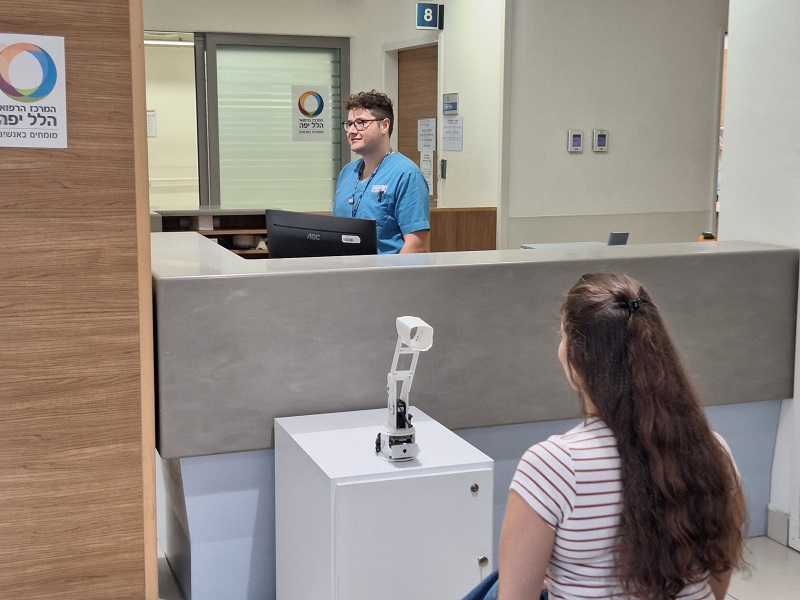
The robot helping to calm people in the emergency room at Hillel Yaffe
How was the study conducted?
The robot was placed in Hillel Yaffe's Emergency Room, a challenging environment where close to 140,000 patients are treated every year, making it one of the busiest in Israel. A stressful environment by any measure.
Patients waiting for care were divided into three groups: one group exposed to a robot that showed interest and interacted with the patient directly; a second group exposed to a robot that examined the environment but did not focus on the patient, and a control group without a robot.
The results, which were statistically significant, were remarkable. Participants who sat next to the robot that was attentive solely to them smiled much more and reported significantly lower stress levels. They described a feeling that "someone sees them" and "is accompanying them.” The most surprising discovery was the strength of the connection that was formed: "They didn't want to return to their companion," explained Mahmoud Hamdan, a nurse in Hillel Yaffe's Emergency Room who oversaw the project along with the ER staff, and Yuval Rubin from the Reichman University research team. "They preferred to sit facing the robot and didn't interpret its presence as something that would expedite their treatment, but simply felt that they weren’t alone."
First study and future implementation idea
The study is considered the first of its kind given that it examined this type of robotic object in a clinical setting outside of laboratory conditions. The researchers are already planning follow-up studies to explore the robot's impact on patients and the medical staff in additional settings. "In the future, we may see simple robots like these placed in hospital departments and emergency rooms," noted the researchers. "This requires further investigation, but it's now clear that these robots can provide a sense of security and calm in the most unexpected places."








.jpg?BannerID=39 "youtube channel")